Alalia in a child: when hearing is fine but speech never comes
Alalia is a condition in which a child's hearing is intact and intelligence is broadly intact, yet speech never unfolds. Not "talks a little" — it does not start at all: by three or four there are no words, or about ten, and no more are added. The cause lies neither in language nor in character — the speech areas of the cerebral cortex have not begun to work.
Parents arrive with the same sentence: "he understands everything, he just doesn't talk". Sometimes that is true, and then we are dealing with the motor form. And sometimes it turns out the child understands far less than it seems and is navigating by gestures, intonation and the setting. That is a different form and completely different work.
Three forms, and each recovers differently
Separating the forms is not a theoretical nicety. What exactly is impaired determines the whole program: where to start, what is useless, and in what order to move.
| Form | What is impaired | How it looks from outside |
|---|
Motor
(expressive) | The program of speech movement does not form. The child knows what to say but cannot build the articulation and assemble the word. | Understands speech addressed to them, follows requests, points to pictures by name. Speaks in fragments of syllables, words are distorted beyond recognition, plenty of gestures and humming. Often gets angry and abandons the attempt. |
Sensory
(receptive) | Speech is physically audible, but the brain does not recognise it as speech: sounds do not add up to meaning. | Does not respond to their name, behaves like a hard-of-hearing child even though the audiogram is normal. May echo what they hear without understanding it. Reacts to noise, music and intonation — but not to words. |
Sensorimotor
(mixed) | Both sides at once: perception and production. | The most common variant among the families who come to us. The child barely speaks and understands selectively — only everyday phrases in a familiar situation. |
A practical test. If the child fetches their shoes when you say "let's go for a walk", that is not yet understanding of speech — it is understanding of the situation. The check is simple: say the same phrase in a level voice, from another room, without looking at the child and outside the usual context. The difference is often surprising.
Where it comes from
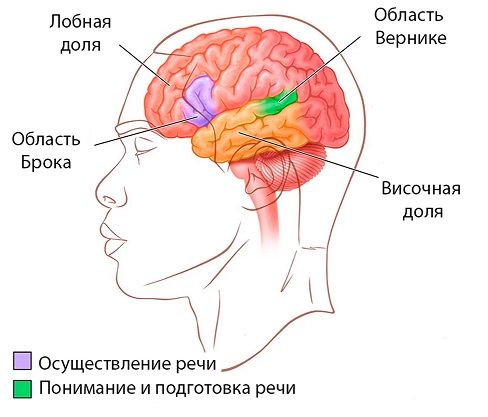
Broca's area is responsible for producing speech, Wernicke's area for understanding it. More about the speech areas.
Behind alalia there is almost always early damage to the speech areas, or a failure of them to mature — most often during pregnancy and birth. The same lines turn up again and again in these children's records:
- foetal hypoxia, cord entanglement, precipitate or, conversely, prolonged labour, emergency caesarean section;
- prematurity, low birth weight, prolonged newborn jaundice;
- intrauterine infections;
- head injury or neuroinfection in the first or second year of life;
- severe repeated ear infections during exactly the period when the child should have been listening in to speech.
An important caveat: many children with such a history develop speech normally, and some children with alalia were born without a single complication. The history explains, but it does not predict. So look at the child, not at the discharge summary.
When waiting is no longer an option
The most expensive mistake in alalia is a year of waiting. "Boys start later", "his grandfather spoke at four" — that is true for a variant of normal development, but not for alalia: here the mechanism does not start by itself, and lost time is not made up automatically. See a specialist if:
- by 12 months there is no babble — no repeated syllables such as "ba-ba-ba", "da-da-da";
- by 18 months there is no pointing gesture and fewer than ten words, even made-up ones;
- by 2 years there is no two-word phrase ("mummy give", "car bang");
- by 2.5 years the child cannot follow a simple request without a gesture or a prompt;
- by 3 years there is no ordinary phrase speech, or speech exists but strangers cannot understand it;
- at any age speech was there and disappeared or became noticeably simpler — that is a reason to seek help urgently.
The earlier work begins, the shorter the road: a child's brain reorganises markedly more easily up to the age of five or six, and the same task costs a fundamentally different number of hours at three and at seven.
What to rule out before sessions begin
Before working on speech, you need to be sure that speech is really the problem. The minimum set:
- hearing — not "reacted to a clap", but an objective test (otoacoustic emissions, and where there is doubt, ABR). Reduced hearing produces a very similar picture;
- a neurological examination — muscle tone, seizure readiness;
- EEG — especially if speech was there and was lost, or if there are absences or night-time seizures;
- an assessment by a speech pathologist — to separate alalia from developmental delay, dysarthria and autism spectrum disorders.
How alalia is treated in our centers
We work not with the diagnosis written in the file but with what is actually impaired in this particular child. So everything starts with a consultation, at which the form, the depth of the disorder and the order of the steps are established. Then a combination of several approaches is chosen.
- High-Frequency Therapy — the center's own method. The speech areas are stimulated with voice signals through ordinary and bone conduction headphones, and the program is written individually for the disorders found. This is the main tool in the sensory and sensorimotor forms: first the brain is taught to hear speech as speech, and only then does it make sense to work on sounds.
- Micropolarization — stimulation of areas of the cortex with a weak direct current, following a scheme designed for that particular child. It is used more often in the motor form, where understanding is present but the speech movement does not come together.
- The Z-Vibe massager — oral motor massage that parents do at home every day. It is needed where oral praxis is affected: the child cannot hold a tongue position, chews poorly, cannot copy a movement with their lips.
- SpeechLeader — a program for the stage when words have appeared but sound imprecise: work on pronunciation, phonemic hearing and the size of the active vocabulary.
- The vibrophone — brings the tactile receptors of the hands into the perception of sound. It helps hold attention on sound in children who let speech pass them by.
- Oxygen therapy — a supporting procedure for children with the consequences of hypoxia.
A course of high-frequency therapy is 25-35 hours of work, spread over days in whatever rhythm suits the family, at the center or at home. Families from other cities receive the program to run at home with a specialist's support.
What we do not do. We do not promise a result "off the price list" and we do not prescribe therapy in absentia, from a description in a message. What exactly is impaired can only be established by seeing the child — at an in-person consultation or, for families further away, on video with specific tasks performed.
What parents can do at home while the work goes on
- Remove background speech. A television running constantly does not develop speech in sensory alalia; it teaches the brain to filter speech out as noise.
- Speak more briefly. One request — one phrase of two or three words, looking at the child's face. Long constructions are not parsed, and the child stops listening.
- Do not demand repetition. "Say: mummy" has exactly the opposite effect on a child with motor alalia: they already cannot, and they begin to avoid trying.
- Leave a pause. Do not finish the sentence for the child and do not fulfil a request at the first glance — give them a few seconds to try.
- Support gesture and pictures. Gesture does not hold speech back; it keeps communication alive until the word arrives.
Frequently asked questions
Is alalia permanent?
No. Alalia is not a sentence and not a personality trait — it is speech areas of the brain that have not formed. Speech does start in these children; the question is how much time and work it takes. The decisive factor is the age at which you begin: what takes one course at three years old takes several at seven.
How does alalia differ from a speech development delay?
With a delay, speech follows its normal path, only more slowly: words appear later than the norm, but they appear on their own and accumulate. With alalia the mechanism does not start — the child stays on ten words for years, and time alone changes nothing. That is why "waiting until three" in alalia means a lost year.
My child is two and silent. Is that already alalia?
At two the diagnosis is usually not made yet, but that is exactly the age at which you can see whether the groundwork is there: does the child understand speech addressed to them, do they point, do they try to imitate. A consultation at two is not about a diagnosis — it is about whether to intervene now or whether watching is enough.
We were told it is autism, not alalia. How do you tell them apart?
Sensory alalia is genuinely often mistaken for autism: the child does not respond to their name, seems not to hear, and speech passes them by like background noise. The difference is in the motivation to communicate — a child with alalia pulls you by the hand, points, looks for the adult's eyes; they simply cannot make use of a word. These states cannot be told apart in ten minutes in an appointment; it takes observation and a hearing test.
From what age do you accept children for restoration?
From two years old. A younger age is considered case by case: sometimes it makes sense to start earlier, sometimes it is better first to remove what is getting in the way, for example repeated ear infections and reduced hearing.
Book a consultation
A consultation is needed to see the child and understand what exactly is impaired. Its outcome is a program of sessions built for that particular child, not "for the diagnosis".
Contacts and booking How the therapy works
See also
This material was prepared by the specialists of the Vlada Tarasenko Speech Restoration Centers. This material is for information only and does not replace an in-person consultation with a doctor or a speech pathologist. Only a doctor can make a diagnosis.